
If you’ve walked past a restaurant, retail shop, or office building in the fall and noticed a temporary enclosure going up around the front door, you’ve seen a vestibule enclosure in action. These structures — also called winter vestibules, storm enclosures, or temporary entry enclosures — are one of the most practical investments a NYC business owner can make. They block cold air, cut heating costs, and keep customers comfortable as they enter and exit.
But before you order one, there’s a question almost every business owner asks: Do I need a permit for this?
The answer depends on what type of vestibule you’re installing, how far it extends beyond your building line, and whether it’s seasonal or permanent. After more than three decades of fabricating and installing enclosures across New York City and New Jersey, the team at Signs NYC has helped hundreds of business owners navigate this process. Here’s everything you need to know.
Two Types of Vestibule Enclosures
The first thing to understand is that there are two fundamentally different categories of vestibule enclosures in NYC, and each is governed by different rules.
1. Temporary / Seasonal Vestibules
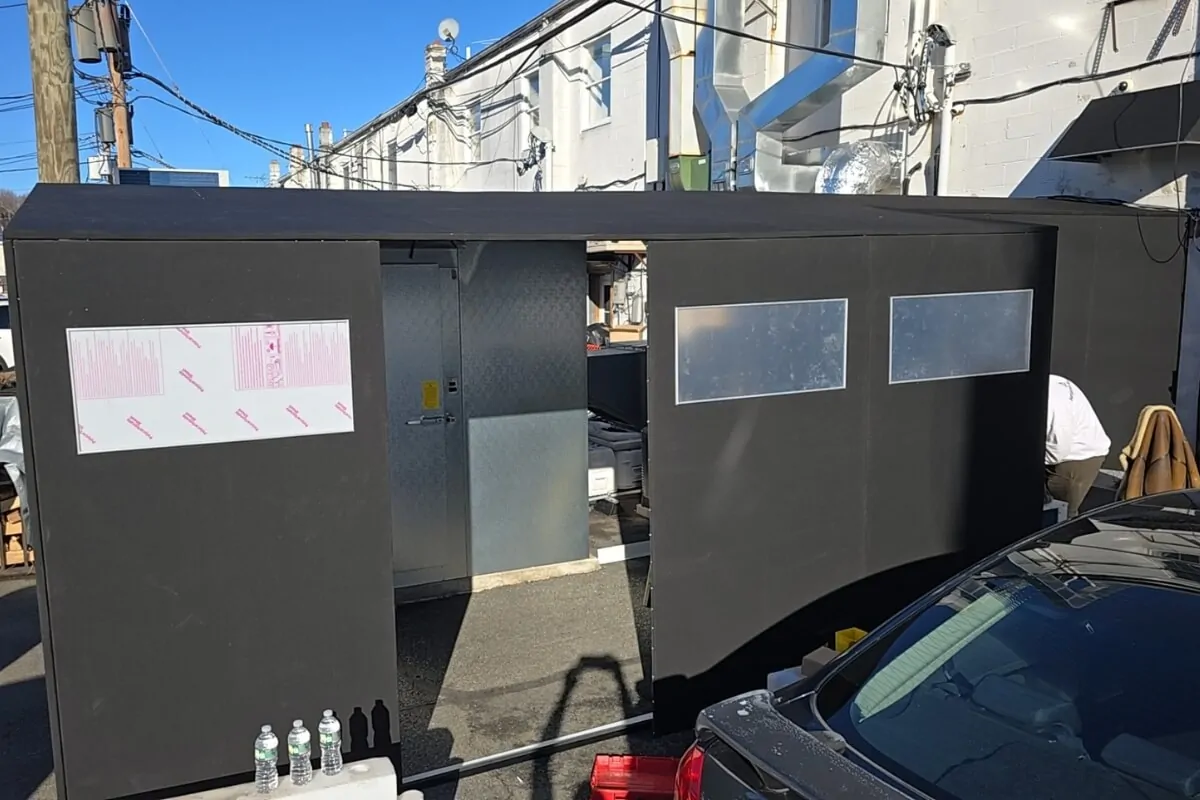
These are erected each fall and removed each spring. They’re typically constructed from lightweight aluminum frames with canvas fabric panels, polycarbonate, acrylic, or plexiglass, and can be installed and uninstalled in a matter of hours. This is the most common type for restaurants, cafés, retailers, and small businesses.
2. Permanent Vestibules
These are built once and remain year-round. They’re often integrated into the building’s façade and involve more substantial construction — framing, glazing, weather sealing, possibly heating or lighting. These require a formal DOB building permit and are treated as a building alteration.
Most businesses in NYC opt for seasonal vestibules, so we’ll cover those in detail first.

Temporary Vestibules: What the NYC Building Code Actually Says
Seasonal storm enclosures are governed by NYC Building Code Chapter 32 (Encroachments Into the Public Right-of-Way), specifically Section 3202.3.2 and the related subsections. Here’s a plain-English breakdown of what the code requires.
The Permitted Season
Temporary storm enclosures may only be in place from November 15 through April 15. They must be fully removed by April 15 each year. No exceptions. If your enclosure is still up when spring arrives, you risk DOB complaints and fines.
The 18-Inch Rule (General)
For most businesses — retail shops, offices, medical offices, service businesses — a temporary vestibule may project no more than 18 inches beyond the street line (i.e., your building’s property line at the sidewalk edge).
This 18-inch limit is smaller than most people expect. For a narrow entranceway, it may not leave a lot of room, but it’s enough to create a meaningful wind buffer — especially with well-designed doors and panel systems.
The Restaurant Exception: 25 Square Feet
Under Section 3202.3.2.1 of the 2022 NYC Building Code, eating and drinking establishments get more flexibility. Restaurants, cafés, and bars may install a temporary storm enclosure with a projection of up to 25 square feet in area — beyond the 18-inch rule — provided:
- A minimum clear unobstructed sidewalk width of 5 feet is maintained at all times
- Door maneuvering clearances comply with Chapter 11 (Accessibility) and the relevant standards in ICC A117.1 Section 404
This larger footprint allowance was introduced in the 2022 building code and reflects the outsized role restaurants play in NYC street life.
Do You Need a Permit for a Temporary Vestibule?
Here’s the answer most business owners are looking for:
Temporary seasonal vestibules that comply with all dimensional and code requirements generally do not require a formal DOB permit.
The NYC Building Code treats compliant seasonal enclosures as permitted encroachments by right — meaning you don’t need to file a permit application with the Department of Buildings, provided you stay within the rules.
That said, there are several situations where additional approvals may be required:
- If your enclosure extends beyond 18 inches (or beyond the 25 sq ft restaurant allowance), you may need a NYC DOT Revocable Consent — a formal grant of right to use the public sidewalk space. This process takes approximately six months to one year and involves public notice and annual fees.
- If you’re attaching brackets, awnings, or structural ties to the building façade, a DOB permit may be triggered.
- If your building is in an LPC historic district or is a designated landmark, the Landmarks Preservation Commission (LPC) requires review and approval for any exterior element, including vestibule attachments.
- Borough-specific interpretations vary. When in doubt, call 311 or consult with a licensed expediter to confirm the requirements for your specific building and location.
Material & Construction Requirements
The code isn’t just about size — it also specifies how a vestibule must be built.
Fire Resistance
The enclosure must meet the fire-resistance rating of the building to which it is appurtenant. This is particularly relevant for older buildings with specific fire ratings.
Light-Transmitting Plastics (Polycarbonate/Acrylic/Plexiglass)
Polycarbonate, acrylic, and plexiglass panels fall under the “light-transmitting plastic” category in the building code (BC § 2606.4). These materials must:
- Be not easily ignitable (tested and rated accordingly)
- Have a low smoke-density and smoke-developed combustibility rating
- Be installed in sections no larger than 300 square feet
- Not be attached to the building exterior at a height greater than 50 feet above grade
For most ground-floor business vestibules, these requirements are easily met by commercially available vestibule systems designed specifically for the NYC market.
Canvas Fabric Panels
Canvas fabric is a common vestibule material used alongside or in place of rigid panels — particularly on the side and top sections where opacity or weather protection is the priority over visibility. Canvas does not fall under the light-transmitting plastic rules, but it must still meet the building’s fire-resistance requirements. Vestibule-grade canvas must comply with NFPA 701 (Standard Methods of Fire Tests for Flame Propagation of Textiles and Films), which is the relevant fire safety benchmark for fabric used in structures.
Not all canvas is equal. At Signs NYC, we use Sunbrella® fabric — a premium, American-made solution fabric manufactured by Glen Raven in Burlington, North Carolina. Sunbrella is NFPA 701 tested and compliant, built for long-term outdoor exposure, and resistant to UV degradation, mildew, and moisture. Using US-made materials like Sunbrella means you’re getting a product built to a higher and more consistent standard than imported alternatives — and one that will hold up through multiple NYC winters without fading, cracking, or delaminating. Always confirm with your fabricator that any canvas or textile material used is fire-rated for commercial use.
Accessibility (ADA / Chapter 11)
Your vestibule cannot obstruct the accessible entrance or route to your building. If the entrance it covers is a required accessible route, the vestibule itself must also be fully accessible — meaning:
- The entry doors must be ADA-compliant in width and operability
- Door maneuvering clearances must be maintained inside the vestibule
- If your building has a step at the entrance, the vestibule cannot make that step harder to navigate
This is an area where professional design and fabrication matters. A poorly designed vestibule can create ADA compliance issues that didn’t exist before.
Permanent Vestibules: What to Expect
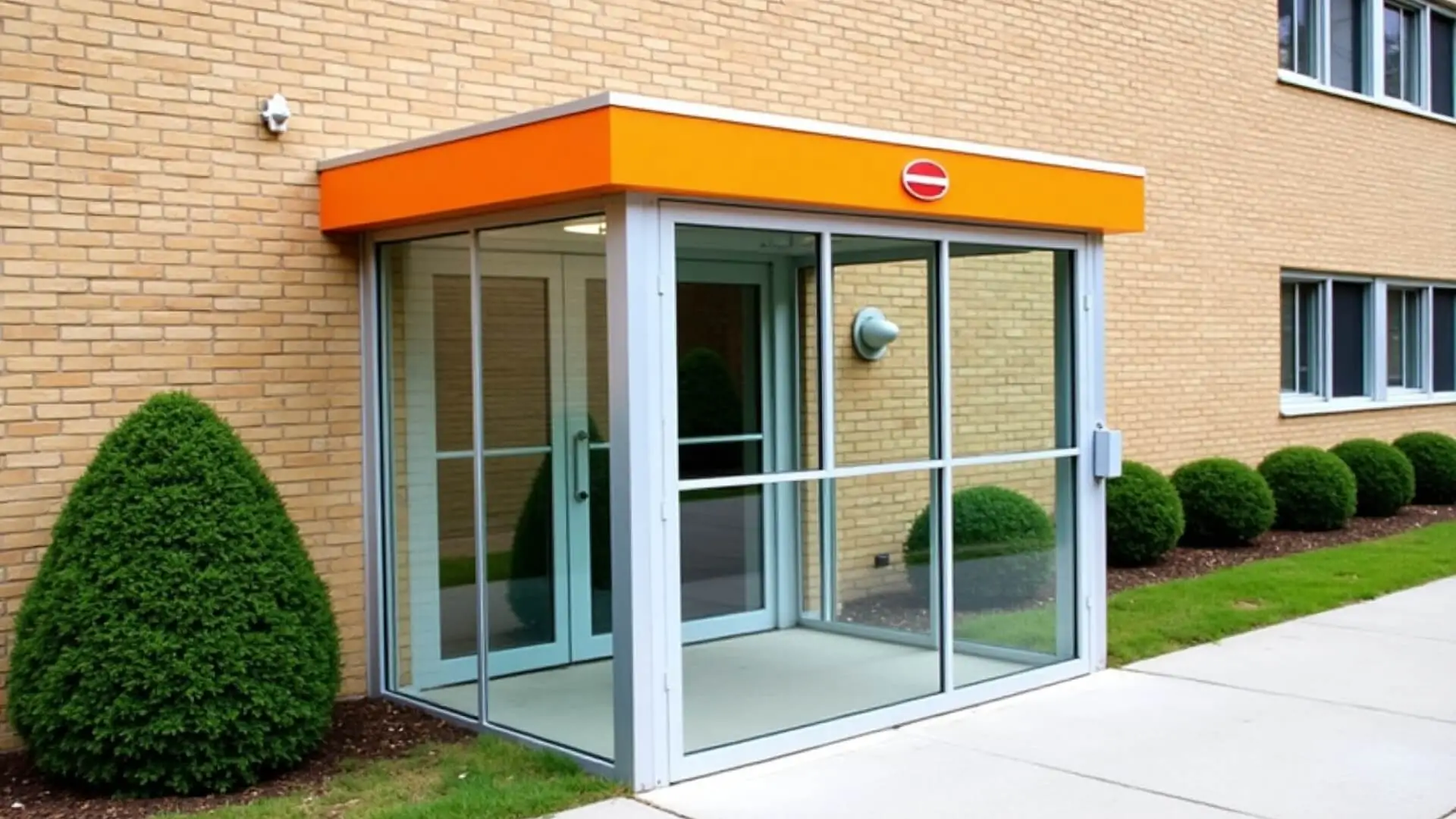
If you’re installing a vestibule that will remain year-round — for example, a built-out enclosed entry with finished interior finishes, HVAC, or a more substantial structure — you’re entering permit territory.
DOB Alteration Permit Required
A permanent vestibule is treated as a building alteration under NYC law. Depending on scope:
- Alt-3 permit: For single, minor work types that don’t affect use, egress, or occupancy — the simplest path
- Alt-2 permit: For work involving more than one trade (e.g., construction + electrical/lighting) — the most common type for vestibules with heating or lighting elements
- Alt-1 permit: Required if the vestibule changes the building’s occupancy classification, egress paths, or results in a new or amended Certificate of Occupancy
All permit applications must be prepared and filed through DOB NOW by a licensed New York State Registered Architect (RA) or Professional Engineer (PE).
NYC Energy Conservation Code Compliance
Permanent vestibules that enclose conditioned (heated or cooled) space must comply with the NYC Energy Conservation Code (NYCECC):
- Vestibule walls forming part of the building envelope must meet insulation requirements
- If the vestibule is conditioned, HVAC and lighting are also subject to the code
- Importantly: an existing vestibule that separates conditioned space from the exterior cannot be permanently removed — this is a hard prohibition under the energy code
Fees
DOB permit fees for permanent vestibule work scale with construction cost. Under Local Law 128 of 2024, a minimum fee of $130 applies per application, and all non-electrical work that doesn’t change the C of O must be paid in full at filing. Professional RA/PE fees add to this — expect total project costs for a modest permanent vestibule installation (permits + design professional + construction) to start in the range of $5,000–$30,000+, depending on scope.
Historic Districts and Landmark Buildings
If your business is located in one of NYC’s many historic districts or your building is a designated landmark, additional review by the Landmarks Preservation Commission (LPC) is required before any exterior work — including a vestibule.
LPC review applies to any element physically attached to the building, including the vestibule frame, brackets, awnings, lighting, and electrical connections. Notably, LPC’s rules for outdoor dining enclosures (updated in May 2024) offer a model: where structures comply with approved design guidelines, LPC will not require individual review for the structure itself, but will still require review for any attached building elements.
If you’re in a historic district and planning a vestibule installation, start by contacting LPC before any fabrication begins. Unapproved work on landmark buildings can result in stop-work orders and costly removal requirements.
The DOT Revocable Consent Process (When Required)
If your vestibule will exceed the standard dimensional allowances — or if you’re installing a more substantial structure for year-round use — you’ll need a Revocable Consent from NYC DOT. Here’s what that involves:
- Plans prepared by a licensed architect or PE
- Original notarized petition plus 10 copies (for a new petition)
- Property owner consent (if you’re a tenant)
- Filing fee: $100–$750 depending on structure type
- Annual fee for the duration of the agreement (approximately 10 years)
- Insurance requirement for the structure
- Public notice published in two newspapers (combined cost up to ~$1,500)
- Public Design Commission review for most above-grade structures
- LPC review if in a historic district or adjacent to a landmark
- Possible ULURP (City Planning review) in some cases
The full process typically takes six months to one year. The City retains the right to revoke consent at any time.
Quick Reference: Do I Need a Permit?
| Scenario | Permit Needed? | Agency |
| Seasonal vestibule, ≤18 in. projection, non-restaurant | Generally no | — |
| Seasonal vestibule, ≤25 sq ft, restaurant, ≥5 ft sidewalk clear | Generally no | — |
| Seasonal vestibule exceeding those limits | Yes — Revocable Consent | NYC DOT |
| Permanent year-round vestibule | Yes — Alt-2 or Alt-3 | NYC DOB |
| Any vestibule on a landmark/historic district building | Yes — LPC review | LPC |
| Heated/conditioned permanent vestibule | Yes + Energy Code analysis | NYC DOB |
| Vestibule with attached awning/canopy to façade | Yes | NYC DOB (+LPC if applicable) |
Why Working with an Experienced Fabricator Matters
Navigating NYC’s building code, encroachment rules, and agency jurisdictions is genuinely complicated — and the stakes are real. An improperly installed vestibule can result in:
- DOB stop-work orders and fines
- Complaints from the community board or neighboring businesses
- ADA violations and potential liability
- Required removal at your expense
That’s why it pays to work with a fabricator who understands not just how to build a vestibule, but how to build one that complies with NYC’s specific requirements.
At Signs NYC, we’ve been designing and installing winter vestibules and enclosures for businesses across New York City and New Jersey since 1989. Every installation we do is designed with code compliance built in — the right dimensions, the right materials (canvas fabric, polycarbonate, acrylic, and plexiglass all meeting applicable fire-resistance requirements), proper door clearances, and complete ADA accessibility. We know the November 15 season timeline inside and out, and we help you plan removal and reinstallation so your business is never caught off-schedule.
Whether you’re a restaurant looking to make the most of the 25 sq ft exception, or a retail business wanting a clean, professional entry enclosure within the 18-inch allowance, we’ll design and fabricate a solution that works for your space.
Ready to protect your entrance this winter?
Contact Signs NYC for a consultation and custom quote. We’ll assess your entrance, confirm the applicable code requirements for your borough and building type, and deliver a professional vestibule enclosure built to last.
Disclaimer: This article is intended for general informational purposes. Building code requirements and permit needs vary based on building type, zoning district, borough, and specific project scope. Always consult with a licensed architect, expediter, or the NYC Department of Buildings to confirm requirements for your specific situation.

3 thoughts on “NYC Vestibule Enclosures: Permits, Requirements, and Everything Business Owners Need to Know”
The permit process for vestibules can feel overwhelming, but this guide breaks it down step by step. We always tell our clients to start the permit process early — the DOB doesn’t move fast, and you don’t want to be waiting on approval after November 15 when you could already have it installed.
Comprehensive guide on the permit side of vestibules. NYC regulations can be a maze, so having everything laid out like this is genuinely helpful. The section on requirements is particularly clear. I’ll be sharing this with some of our restaurant clients.
Permits and requirements are where most people get tripped up with vestibules. This guide covers all the bases. We’ve seen too many business owners skip the permit step and regret it when the DOB comes knocking. Do it right the first time — it’s worth the effort.