
The physical environment of a school has a measurable effect on student outcomes. Research in educational psychology and built environment design consistently shows that students learn better, focus longer, and feel more connected to their school community in visually rich, carefully designed spaces.
Custom school wall wraps — large-format vinyl graphics applied directly to walls, doors, hallways, and gym floors — are one of the most cost-effective ways to transform a school’s environment without construction or renovation. Signs NYC installs educational wall graphics for public schools, private schools, charter schools, and universities across New York City, New Jersey, and the Tri-State Area.
The Learning Environment and Visual Stimulation
A 2015 study by the University of Salford found that classroom design (including visual elements) accounted for a 16% variation in student learning progress over a year — one of the largest environmental factors measured. While the full picture is complex, the evidence consistently supports the intuition that visual environments matter.
For schools in NYC, where many buildings date back decades and budgets for capital improvements are limited, wall wraps offer a powerful, reversible, and relatively affordable way to modernize a space and reinforce the school’s values.
Visual Learning in Early Education
For young learners in Pre-K through grade 3, visual stimuli serve an active educational function. Alphabet murals, number lines, world maps, and illustrated timelines on classroom walls are not merely decorative — they are learning tools that students interact with throughout the day. Signs NYC works with educators to design educational murals that meet curriculum goals while creating a visually engaging environment.
Motivation and School Pride
For middle and high school students, wall graphics that express school identity — mascots, colors, mission statements, achievement recognitions — build community and school pride. Hallways, gymnasiums, and common areas with strong visual identities feel like places students want to be, not just places they have to be.
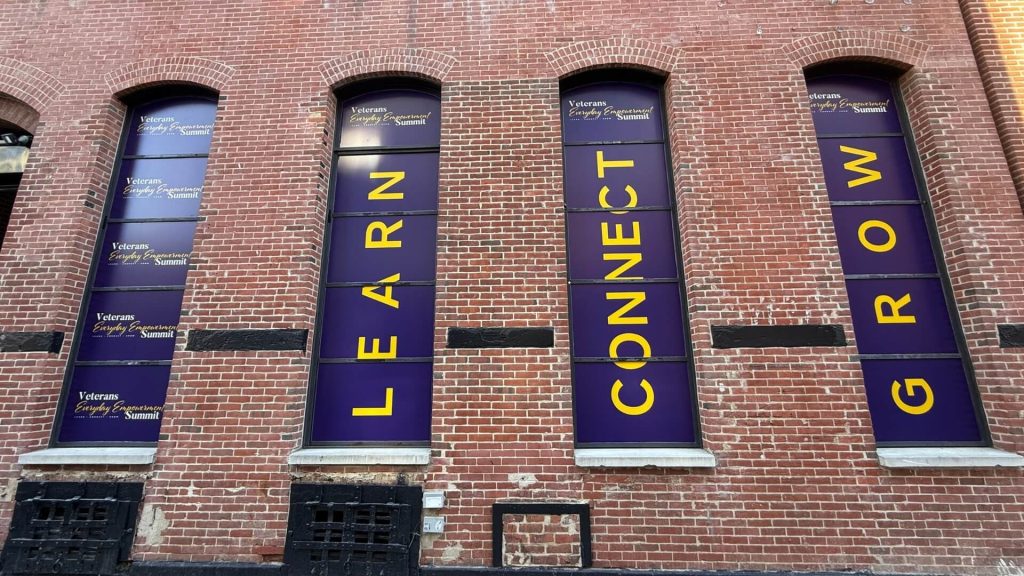
Application Zones Across a School Facility
Classrooms
Classroom wall wraps can serve an educational purpose (alphabet, vocabulary, number grids, maps, timeline murals), a motivational purpose (growth mindset quotes, “Yet” language, aspirational imagery), or simply a visual enrichment purpose (nature scenes, world cultures, STEM themes). Signs NYC works with teachers to align classroom graphics with their specific curriculum and grade level.
Main Lobby and Entry
The school lobby is the first impression for students, parents, and visitors every day. A large logo mural, a statement of the school’s mission, or a recognition wall displaying student achievements creates a powerful welcome. Signs NYC has executed floor-to-ceiling lobby murals for NYC public schools that transform institutional entry halls into spaces of pride.
Hallways and Corridors
Long hallways offer an opportunity for visual storytelling. Historical timelines, maps, literary quotes, STEM graphics, or a rotating gallery of student artwork printed as wall wraps all create engaging environments for students during transitions. Hallway graphics also serve a wayfinding function, using color zones and illustrated landmarks to help younger students navigate large buildings.
Gymnasium
School gym wall wraps typically feature athletic imagery, school colors, and the mascot. A professional-quality graphic on the gym walls signals to student-athletes and visiting teams that this is a competitive, well-maintained athletic facility. For many NYC public schools, this is a meaningful statement of institutional pride that goes beyond aesthetics.
Cafeteria
The cafeteria is where students spend significant unstructured time together. Colorful, engaging wall graphics — community murals, illustrated global foods, motivational messaging, or artistic interpretations of school values — make the cafeteria feel welcoming rather than institutional.
Outdoor Walls and Pavement
Signs NYC also produces outdoor murals on exterior school building walls using UV-resistant outdoor vinyl designed to withstand NYC weather conditions. Playground pavement graphics (directional games, hopscotch, maps, activity zones) use floor-rated slip-resistant vinyl appropriate for outdoor use.

| Banner Size | Common Application | Typical Viewing Distance |
| 1′ x 3′ | Tabletop display, indoor use | 3–8 feet |
| 2′ x 4′ | Small storefront, indoor event | 5–15 feet |
| 3′ x 6′ | Standard retail/event banner | 10–25 feet |
| 4′ x 8′ | Grand opening, building exterior | 15–40 feet |
| 4′ x 12′ | Scaffolding, construction hoardings | 20–60 feet |
| 4′ x 20′ or larger | Building wrap, large outdoor display | 30–100 feet |
For banners viewed by pedestrians on a NYC sidewalk, text should be legible from 10–20 feet. Use a minimum font height of 1 inch for every 10 feet of viewing distance. For a 30-foot viewing distance, headlines should be at least 3 inches tall.
Step 2: Design Your Banner
The most common mistake in banner design is trying to communicate too much. A banner has 1–3 seconds to capture the attention of a moving pedestrian or driver. In those seconds, it can communicate your brand, your offer, and a call to action — if the design is disciplined and well-executed.
Design Principles for High-Impact Banners
- Brevity: No more than 7–10 words for the primary message. Secondary text can add detail, but the primary headline must read in a glance.
- Contrast: Your text must contrast sharply with its background. Dark text on light backgrounds, or white text on dark/saturated backgrounds, is universally legible. Mid-tone-on-mid-tone is consistently a mistake.
- Hierarchy: One element should dominate — usually your primary headline or offer. Everything else should be subordinate.
- Color: Limit your palette to 2–3 colors. More colors create visual noise.
- White space: Empty space is not wasted space — it makes your key message stand out.

Working With Signs NYC Designers
If you do not have print-ready artwork, Signs NYC’s in-house graphic design team will create original banner artwork based on your brief.
Step 3: Choose Your Banner Material
Standard 13 oz Scrim Vinyl (Most Common)
The most widely used banner material for outdoor applications.
18 oz Blockout Vinyl
Heavier and more opaque than 13 oz, used for double-sided banners and high-traffic areas.
Mesh Vinyl
Mesh vinyl has perforations that allow wind to pass through the material.
Fabric / Satin Banner Material
Fabric banners are used for indoor applications where a premium appearance is required.
A vinyl banner stored properly and reused year after year has an effective cost-per-impression that rivals any advertising medium available to a small business. At Signs NYC, we’ve seen well-cared-for banners still in service 7–8 years after printing.
