
The Short Answer
- LPC approval comes first for any sign on a landmark building or in a historic district. DOB needs it before issuing the sign permit.
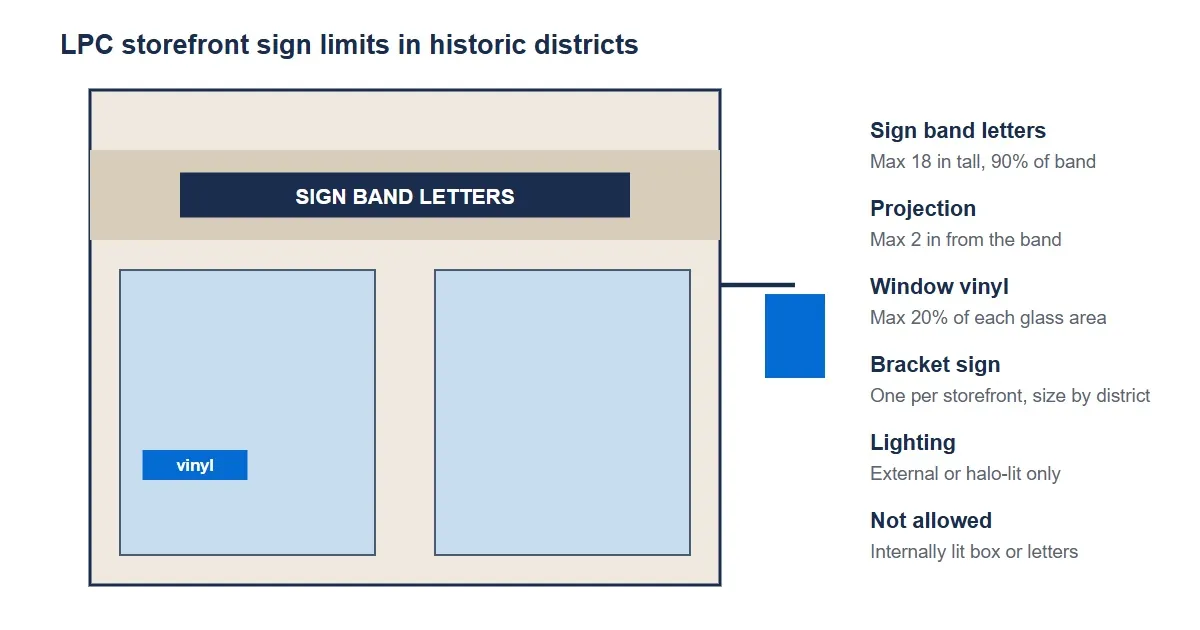
- Sign band letters can be up to 18 inches tall, cover up to 90% of the band and project no more than 2 inches.
- Window vinyl can cover up to 20% of each glass area. Bracket sign size depends on the district's history.
- External lighting and halo-lit letters are allowed. Internally lit box signs and letters that light through the face are not.
Is Your Building Landmarked
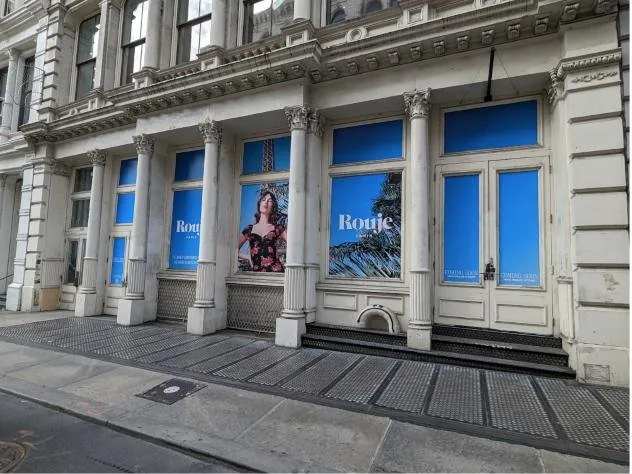
Search the address on LPC's Discover NYC Landmarks map. If the building is an individual landmark or sits inside a historic district, every exterior sign needs an LPC permit. Large parts of Manhattan, Brooklyn Heights, Park Slope, Fort Greene and many other neighborhoods are historic districts.

Signs That Need No LPC Permit
- Interior signs set more than 18 inches behind the display window.
- Sandwich boards and temporary signs that do not attach to the building.
- Replacing previously approved painted or vinyl window signs, or lenses in an approved box.
- Temporary glass-only signs for a sale or lease, or covering interior construction, removed when the work ends.
- Banners or flags on an armature that was approved before.
Sign Types and Size Limits
| Sign type | LPC limits |
|---|---|
| Painted or pin-mounted letters in the sign band | Letters and logos cover up to 90% of the band; letters max 18 in tall, project max 2 in |
| Flat sign panel in the sign band | Wood, metal or opaque glass; up to 90% of the band; letters max 18 in; panel projects max 2 in (4 in with raised letters) |
| Letters on a metal channel | Channel max 1 in tall; letters max 18 in tall, project max 2 in |
| Vinyl on glass | Max 20% of each glass area; not on leaded or stained glass |
| Plaques | 288 sq in on small buildings, 432 sq in on larger ones; max 1.5 in thick |
| Menu boxes | Max 28 x 30 in |
Bright neon or other vivid colors are not allowed on sign band letters or bracket signs. Signs must not cover or damage architectural details such as cornices, cast-iron columns or transoms.
Bracket Signs
| District history | Max sign size | Max projection |
|---|---|---|
| Historically manufacturing or industrial | 24 x 36 in | 40 in |
| Historically commercial | 18 x 24 in | 18 in |
| Historically residential | 12 x 18 in | 12 in |
One bracket sign per storefront, two at qualifying corners. The arm goes below the second story, on the storefront opening or a plain pier, not on cast iron. Max thickness is 2 inches, or 3 inches with raised letters. NYC zoning projection limits apply too.
Lighting
Small external light fixtures above the storefront (up to 1 per 6 ft of opening), cove lighting in the sign band, and halo-lit letters with hidden light sources.
One interior neon sign per display window, at least 6 in behind the glass, covering no more than 15% of the window.
Internally lit box signs, letters lit through the face or sides, internally lit bracket signs and light strips outlining windows.
See how halo lighting works in our guide to front-lit vs halo-lit channel letters.
How to Apply
- Apply in PorticoLPC's online system. Applications that meet the rules can be approved by staff, which is faster.
- PhotosColor photos of the whole building and close-ups of the storefront.
- DrawingsStorefront elevation with the signs and lights, dimensioned sections, letter heights and install details.
- SpecsColors or paint cards, material cut sheets and light fixture details.
- DOB filingAfter LPC approval, the DOB sign permit is filed with the approved drawings.
Proposals that do not meet the rules go to the full Commission at a public hearing, which takes longer. We prepare the drawings and work through LPC and DOB. See our sign permit service and the permit cost and timeline guide.
Send the address and a storefront photo. We check landmark status and design a sign that meets LPC rules.
LPC Sign Questions, Answered
Do I need LPC approval for a sign in a historic district?
Yes, for exterior signs on a landmark building or in a historic district. LPC approval comes before the DOB sign permit.
How big can letters be on a sign in a NYC historic district?
Up to 18 inches tall, covering no more than 90% of the sign band, projecting no more than 2 inches.
Are lit signs allowed in NYC historic districts?
External lighting and halo-lit letters are allowed. Internally lit box signs and letters lit through the face are not.
How much window vinyl does LPC allow?
Up to 20% of each glass area, measured without subtracting the gaps between letters. Not on leaded or stained glass.
Can LPC staff approve my sign without a hearing?
Yes, if it meets LPC's rules. Proposals that do not meet them go to the full Commission at a public hearing.
Ask a Sign Maker
Is your store in a historic district? Send your question with the address. A project manager answers by email within one business day.

Abie S. writes for Signs NYC. Signs NYC has designed, built and installed signs and awnings in New York City since 1995, with shops in Brooklyn and Linden, NJ. About us