
Construction sites across New York City have to meet more than building and safety requirements. The signs posted on a construction fence, demolition site, or sidewalk shed also need to follow the applicable NYC Department of Buildings (DOB) rules.
Missing contact information, an outdated permit expiration date, or a project panel that does not meet the applicable requirements can create compliance problems. Contractors and property owners should check their signage before work begins and keep it updated throughout the project. Not every job site needs the same set of signs. The requirements depend on the type of work, permits, protective structures, and site-safety designation.
This checklist explains the main NYC construction site sign requirements, what information each sign may need to display, and which official rules to check.
Which Signs Does NYC DOB Require at a Construction Site?
The NYC Building Code, particularly Section 3301.9, establishes requirements for signs at construction and demolition sites. Additional rules address specific situations, including sidewalk sheds, demolition work, and site-safety jobs.
The main signage categories to check are:
- Construction fence project information panels.
- Property owner and general contractor identification.
- The 311 unsafe-condition notice.
- Demolition contractor contact information.
- Sidewalk shed permit-holder information and expiration dates.
- Additional contact information for designated site-safety jobs.
- OSHA warning and hazard signs where applicable.
- NYC DOT project information signs for qualifying street and infrastructure work.
Some of these requirements can be satisfied through a prescribed project panel rather than separate signs. Others apply only when the project meets specific conditions. Before ordering signs, identify the applicable requirements for the site rather than assuming every item on this list is mandatory for every project.
NYC Job Site Sign Checklist
Use this checklist to review the main signage categories before construction begins. Confirm the exact wording, dimensions, placement, and exceptions in the applicable code or agency guidance.
| Sign or Information | What to Check | When It Applies |
|---|---|---|
| Construction fence project panel | Required project details, permit information, contractor identification, and prescribed notices. | Construction sites subject to the project-panel provisions. |
| Property owner and general contractor information | Names, addresses, and telephone numbers. | Applicable construction projects. |
| 311 unsafe-condition notice | Prescribed English and Spanish wording, placement, and letter size. | Sites covered by the applicable new-building or demolition provisions. |
| Demolition contractor information | Demolition contractor’s name, address, telephone number, and required complaint information. | Applicable demolition projects. |
| Sidewalk shed sign or parapet panel | Permit-holder contact details and permit expiration date. | Sites with a sidewalk shed, subject to applicable panel provisions. |
| Site-safety contact numbers | Required DOB and other agency contact information. | Designated site-safety jobs. |
| OSHA hazard and warning signs | Warnings for actual hazards and applicable work activities. | As required by workplace safety rules and site conditions. |
| DOT project information sign | Project details, contact information, and prescribed format. | Qualifying DOT-permitted street and infrastructure projects. |
Important: This is a screening checklist, not a substitute for reviewing the governing provisions. The NYC Building Code and DOB rules include specific exceptions and alternative signage requirements.
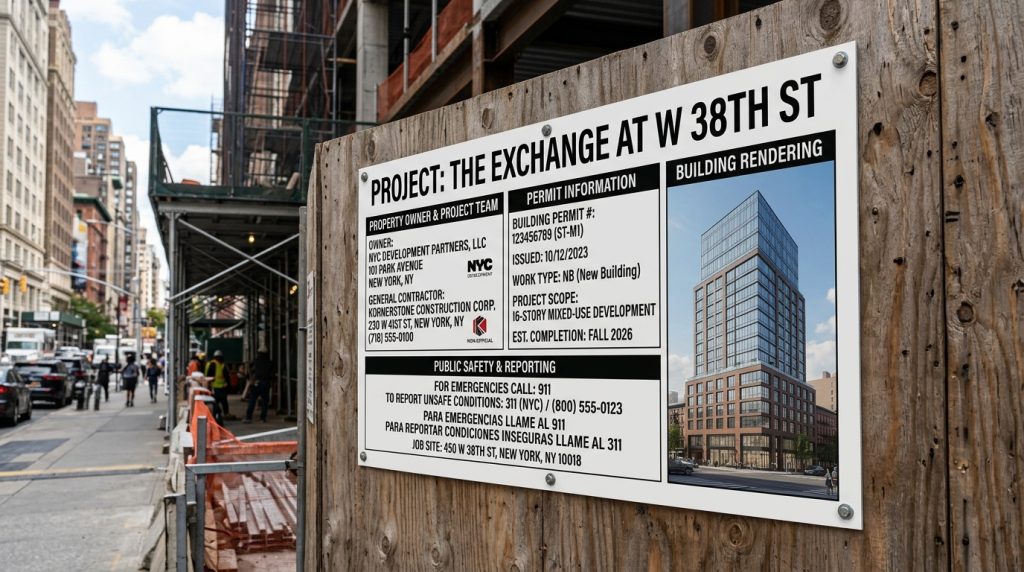
1. Construction Fence Project Information Panel
A construction fence panel gives the public information about the work taking place behind the fence. It is one of the main items to review when preparing signage for a project.
Under NYC Building Code Section 3301.9 and 1 RCNY Section 3301-01, applicable project information panels must contain prescribed information. Depending on the project and applicable rule, this can include:
- Project type and required project information.
- A rendering, elevation, site plan, or zoning diagram.
- The anticipated completion date.
- Property owner and contractor details.
- The required 311 unsafe-condition reporting notice.
- A copy of the primary project permit or the prescribed method of accessing permit information.
The exact content depends on the applicable panel provisions. Government-owned and government-funded sites have specific panel dimensions and formatting rules, with exceptions for certain sites and project types. Those specifications should not automatically be applied to every private construction project. Before fabrication, check the current rule and any project-specific requirements. A panel can look professionally produced and still be incorrect if required information is missing or the wrong format is used.
Official reference: 1 RCNY Section 3301-01.
2. Property Owner and General Contractor Information
Construction signage must identify the responsible parties under the applicable DOB rules. For covered construction projects, DOB’s published guidance identifies the property owner’s and general contractor’s name, address, and telephone number.
Before printing, verify:
- The correct property owner or entity name.
- The general contractor’s current business name.
- The required mailing or business addresses.
- Telephone numbers that can be used to contact the responsible parties.
Do not rely on an old sign from a previous project. Contractor details can change, and a sign with outdated information may no longer serve its purpose. The applicable project panel may already include this information. Check the required format before ordering an additional sign.
Official reference: NYC DOB Construction Signage.
3. The 311 Unsafe-Condition Notice
NYC requires an unsafe-condition reporting notice at sites covered by the applicable rules for new-building and demolition permits.
TO ANONYMOUSLY REPORT UNSAFE CONDITIONS AT THIS WORK SITE, CALL 311
The notice must appear in English and Spanish under the cited rule. The published provisions also specify placement, lettering, and other sign details.
For example, 1 RCNY Section 27-04 specifies a prominent location on each perimeter fronting a public thoroughfare, a maximum height of 12 feet above ground, black lettering on a white background, and letters at least 6 inches high. Do not assume these specifications apply identically to every type of construction sign. The current applicable provision and any alternative project-panel requirements must be checked before fabrication.
The 311 notice may be incorporated into a prescribed project information panel. Confirm whether the project requires a separate sign or whether the applicable panel satisfies the requirement.
Official reference: NYC DOB Construction Signage.
4. Demolition Contractor Information
Demolition projects have specific signage requirements. DOB’s published guidance identifies the demolition contractor’s name, address, and telephone number, along with the required Department of Buildings complaint information. Before a demolition project begins, confirm that the applicable sign or project panel contains the required details.
Pay particular attention to:
- The demolition contractor’s correct business name.
- The required contact address and telephone number.
- The prescribed complaint information.
- Any additional project information required by the applicable demolition provisions.
A standard construction sign should not automatically be treated as sufficient for demolition work. Review the demolition-specific requirements and confirm which panel or sign format applies.
Official reference: NYC DOB Construction Signage.
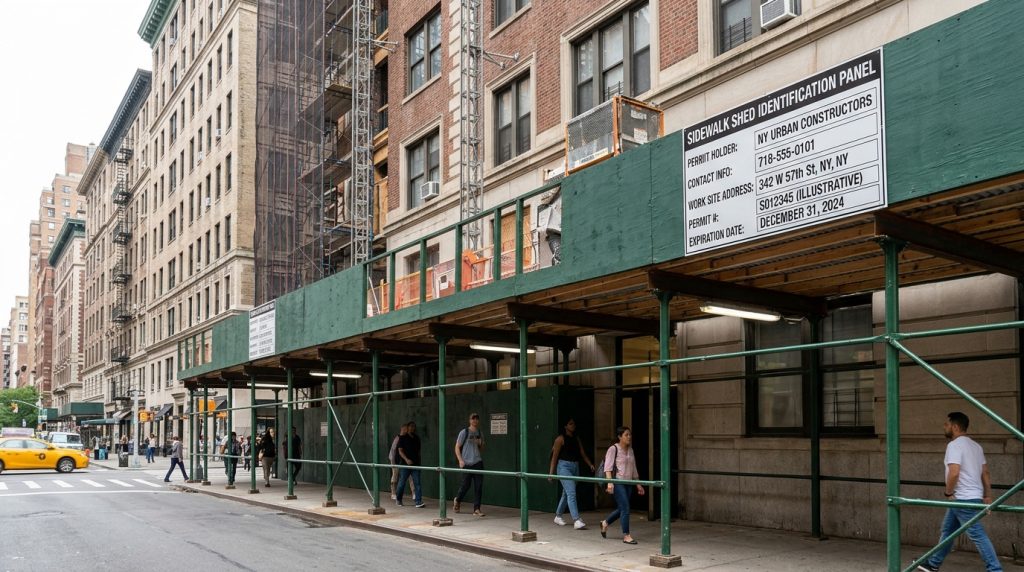
5. Sidewalk Shed Signs and Permit Information
Sidewalk sheds protect pedestrians from potential hazards associated with construction work above or beside a public walkway. They also have their own signage requirements. DOB’s published guidance identifies the permit holder’s name, address, and telephone number, along with the sidewalk shed permit expiration date, as required sign information.
Check the following before the shed is in use:
- The permit holder’s correct name and contact details.
- The permit expiration date.
- The applicable shed sign or parapet panel format.
- Whether the required information is visible and legible.
- Whether the sign is securely attached and maintained.
The sidewalk shed panel is not interchangeable with a construction fence panel. The applicable code provisions distinguish between these structures and specify alternative requirements for certain projects. Do not assume that a sign installed when the shed was first erected will remain accurate for the entire project. Review the displayed information whenever the permit or responsible party changes.
Official references:
6. Additional Contact Numbers for Site-Safety Jobs
Some NYC construction projects have additional site-safety signage requirements. DOB’s published guidance lists the following contact numbers for designated site-safety jobs, in addition to the required construction-project information:
- NYC Department of Buildings: 311.
- Construction Safety Compliance Unit: (212) 393-2404, then press 2.
- Emergency Response Team: 311.
- NYC Department of Transportation: 311.
These numbers should not be presented as a universal list for every construction site. First, confirm whether the project falls under the applicable site-safety provisions. When preparing the sign, verify the current required wording and format against DOB’s official guidance. Contact numbers should be checked before printing so that workers and members of the public can use them when needed.
Official reference: NYC DOB Construction Signage.
7. OSHA Warning and Hazard Signs
DOB project-information signs and workplace safety signs serve different purposes. OSHA’s construction standard, 29 CFR 1926.200, addresses accident-prevention signs, tags, and traffic-control signs and devices. The signs required at a particular site depend on the hazards and work activities involved.
Examples of situations that may require appropriate warnings or traffic controls include:
- Areas with immediate dangers.
- Work zones with potential hazards or unsafe practices.
- Vehicle and equipment movement near workers or pedestrians.
- Restricted work areas.
- Exits and other safety-related locations where applicable.
OSHA specifies different requirements for danger, caution, safety-instruction, directional, and traffic-control signs. The design and wording should follow the applicable standard rather than relying on a generic warning sign. Required signs must remain visible while work is being performed and should be removed or covered promptly when the hazards no longer exist. Contractors should review the worksite’s hazards and applicable OSHA requirements instead of ordering a fixed package of warning signs for every project.
Official reference: OSHA 29 CFR 1926.200 — Accident Prevention Signs and Tags.
8. NYC DOT Construction Project Information Signs
Some street and infrastructure projects fall under NYC DOT’s construction project informational sign requirements. DOT states that permittees must post informational signs for qualifying projects with a projected completion time of three months or more. Examples include roadway reconstruction, major sewer or water work, transit infrastructure, bridge reconstruction, and major utility installations.
The required information and sign specifications differ from those used for DOB-regulated construction sites. DOT’s guidance explains that projects requiring a DOB permit and enclosed by a construction fence, or having a sidewalk shed, follow the applicable DOB construction-signage requirements instead of DOT’s separate construction project informational sign requirement. If the work involves a public street, utility installation, roadway, or other DOT-permitted activity, check which agency’s signage rules apply before producing the signs.
Official reference: NYC DOT Construction Project Informational Signs.
Where Should Construction Site Signs Be Placed?
Correct wording is only part of compliance. Signs must also be installed in the locations and manner specified by the applicable rules.
Place each sign in the required location. Construction fence panels, sidewalk shed panels, and 311 notices have different placement requirements. Do not assume one location satisfies every obligation.
Keep required information visible. The sign should remain legible and accessible to the people it is intended to inform.
Secure the sign properly. DOB requires covered signs to remain securely attached and free of sharp edges, protruding nails, and similar hazards.
Protect signs from the elements. Use appropriate materials and installation methods for outdoor conditions. Where the rule requires a protected permit copy, follow the prescribed method.
Keep information current. Update signs when the applicable permit, contractor, contact details, or other required information changes.
Remove or cover obsolete hazard signs. OSHA requires signs and symbols under its construction standard to remain visible during work and to be removed or covered promptly when the hazards no longer exist.
The best time to check placement is before work starts, followed by inspections during the project and whenever site conditions change.
Common NYC Construction Signage Mistakes
Using the Same Sign Package for Every Project
A demolition site, a construction site with a fence, and a site with a sidewalk shed can have different requirements. Identify the applicable code provisions before selecting the sign format.
Leaving Out Required Contact Information
Check names, addresses, and telephone numbers against the current project records. A sign with outdated details can make it difficult for the public to contact the responsible party.
Printing the Wrong 311 Notice
Use the prescribed wording and languages where required. Do not replace the official text with a shorter marketing-style message.
Ignoring Sign Dimensions and Placement
Some rules specify minimum letter heights, colors, dimensions, or locations. Do not apply one panel’s specifications to another without verifying the governing provision.
Treating OSHA Signs as a Replacement for DOB Signs
A danger or caution sign does not replace a required project information panel, contractor identification, or sidewalk shed sign. Each requirement serves a different purpose.
Allowing Signs to Deteriorate
Faded lettering, damaged panels, loose fasteners, and outdated permit information can undermine the sign’s purpose. Include signage in routine site checks.
Adding Unauthorized Advertising to Protective Structures
NYC Construction Code Section 3307.4.6 restricts signs, information, pictorial representations, business messages, and advertising on protective structures, except as allowed by law. Do not assume a sidewalk shed or construction fence can be used as an unrestricted advertising surface.
Official reference: NYC DOB Construction Site Signage Requirements.
How to Prepare a Construction Site Signage Checklist
- Identify the project type. Determine whether the work is new construction, an alteration, demolition, sidewalk shed work, or DOT-permitted infrastructure work.
- Confirm the applicable permits. Review the project records and determine which signage provisions apply.
- List the required information. Check the names, contact details, permit information, notices, and dates that must be displayed.
- Verify the specifications. Confirm the required sign dimensions, letter sizes, colors, materials, and placement.
- Prepare the artwork. Arrange the information so that required text is legible and presented in the prescribed format.
- Check the installed signs. Confirm that the signs are visible, securely attached, and free of hazards.
- Schedule updates. Review signs when permit details, contact information, or site conditions change.
For projects with several structures or work areas, prepare a separate checklist for each applicable sign location. This makes it easier to track which requirements have been met and which still need attention.
Order Construction Site Signs for Your NYC Project
At Signs NYC, we produce custom construction signs for contractors, builders, and property managers across New York City and New Jersey. From construction fence panels to project information signs, our team handles sign production in-house to help keep your project moving. Share your project details and approved sign specifications with us, and we’ll prepare a quote for your signage. Request a Quote or call 718-453-8300.
Compliance note: This guide is for general informational purposes and is not a substitute for the current NYC Construction Code, DOB rules, project permits, or advice from the project’s qualified design and construction professionals. Verify all applicable requirements before fabrication and installation.
